Thesis first: one paragraph you can defend
What you will learn
- What a thesis is, and why it comes before the numbers
- The eighteen questions you answer before any number
- The four sentences every defensible thesis contains
- A real example: the thesis of our Apple deep dive
- How to write “what would prove me wrong” without flinching
In a school debate, if you cannot state your side in one breath, you do not have a side, only a pile of opinions. Investing works the same way. A deep dive needs a thesis: one short paragraph saying what the business is, why it keeps winning, and what the numbers must do for that to stay true.
Why first? Because everything after the thesis is a test of it. Without one you collect facts like stamps: pretty, organised, proving nothing. With one, every table you build has a job: support the paragraph or attack it.
A defensible thesis has four sentences:
- What the business is, plainly enough that a friend outside the stock market gets it.
- Why it wins: the one mechanism that keeps customers coming back.
- What the numbers must do, with actual figures you can check later.
- What would prove it wrong, written down now, while you are still calm.
Sentence one has a prerequisite: eighteen plain questions, answered before you look at a single number. What the company does, who runs it, what it makes, who buys, who competes, what the barriers are, who audits the books, how many subsidiaries. No formulas anywhere, and that is the point: answering it is work a screen cannot do. The list bends to the business too: six of the eighteen are written for a manufacturer, so reword them for a bank or an insurer, and “promoters” has no clean American equivalent, the nearest being how long management has served and what they own.
Here is a weak thesis, the kind the internet is full of: “Apple is a great brand and everyone loves the iPhone.” A mood, not a thesis: nothing in it can be checked, so it can only be repeated.
Now the thesis from our Apple deep dive, built from the fiscal 2025 10-K:
Apple sells devices, and then sells services to the people who own them. The iPhone was $209.6 billion of the $416.2 billion of revenue in fiscal 2025, half of the company, and it is the toll booth: once someone owns it, the App Store, iCloud, Music, payments and warranties flow through it. Those services were $109.2 billion, 26.2% of revenue, but because they carry a 75.4% gross margin against 36.8% on products, they produced 42.2% of the company’s gross profit. The thesis is that the mix keeps shifting: services were 14.3% of revenue in fiscal 2017 and 26.2% now, and each point of the shift makes the company more profitable per rupee of sales. What would prove it wrong: services margin falling, the App Store’s commission rules being rewritten by courts or regulators, or the device base shrinking, starting in China.
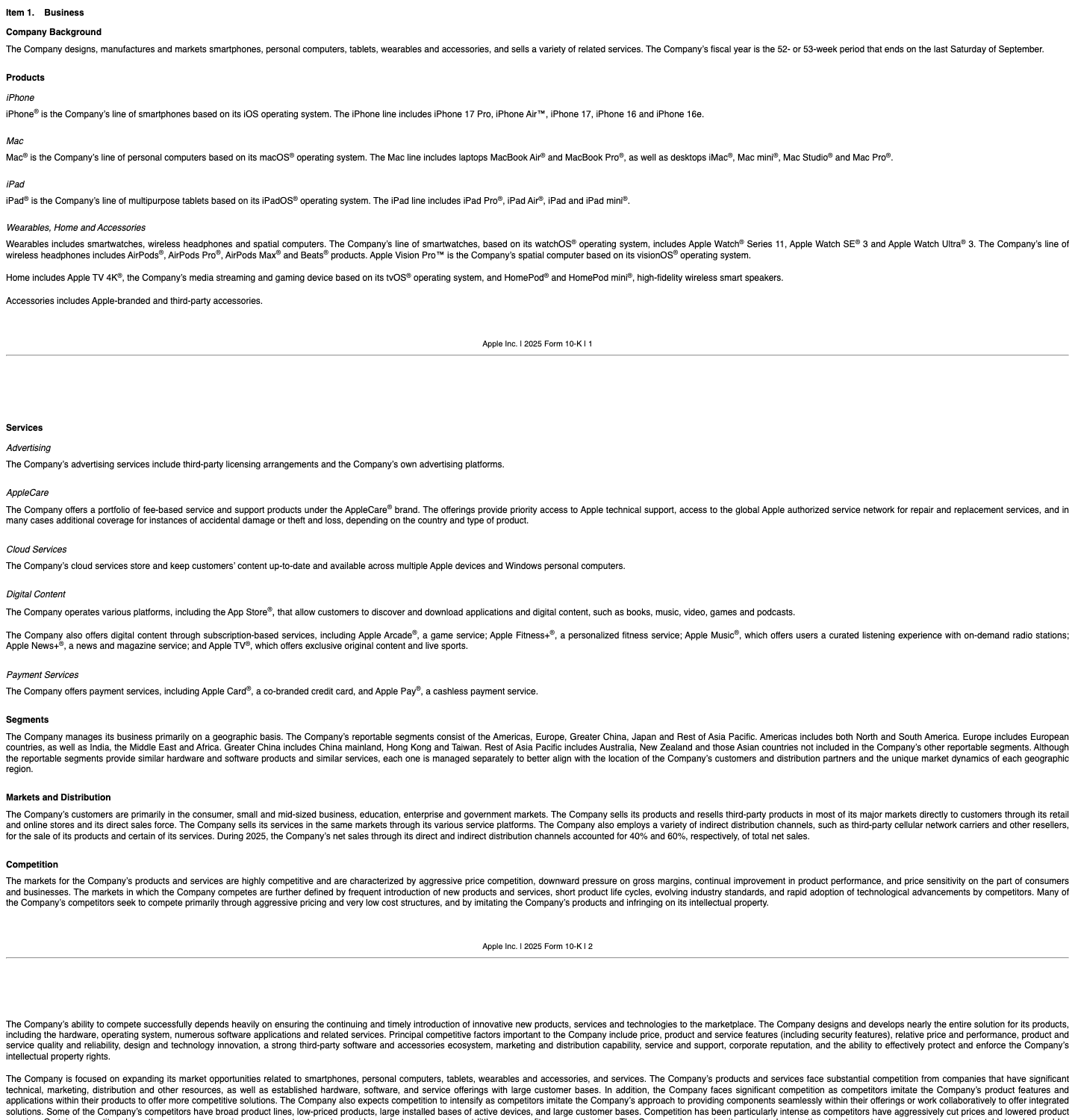
Notice where the paragraph came from: Item 1 of the 10-K, where the company must describe its own business, plus the revenue note splitting sales by category. No guru was consulted.
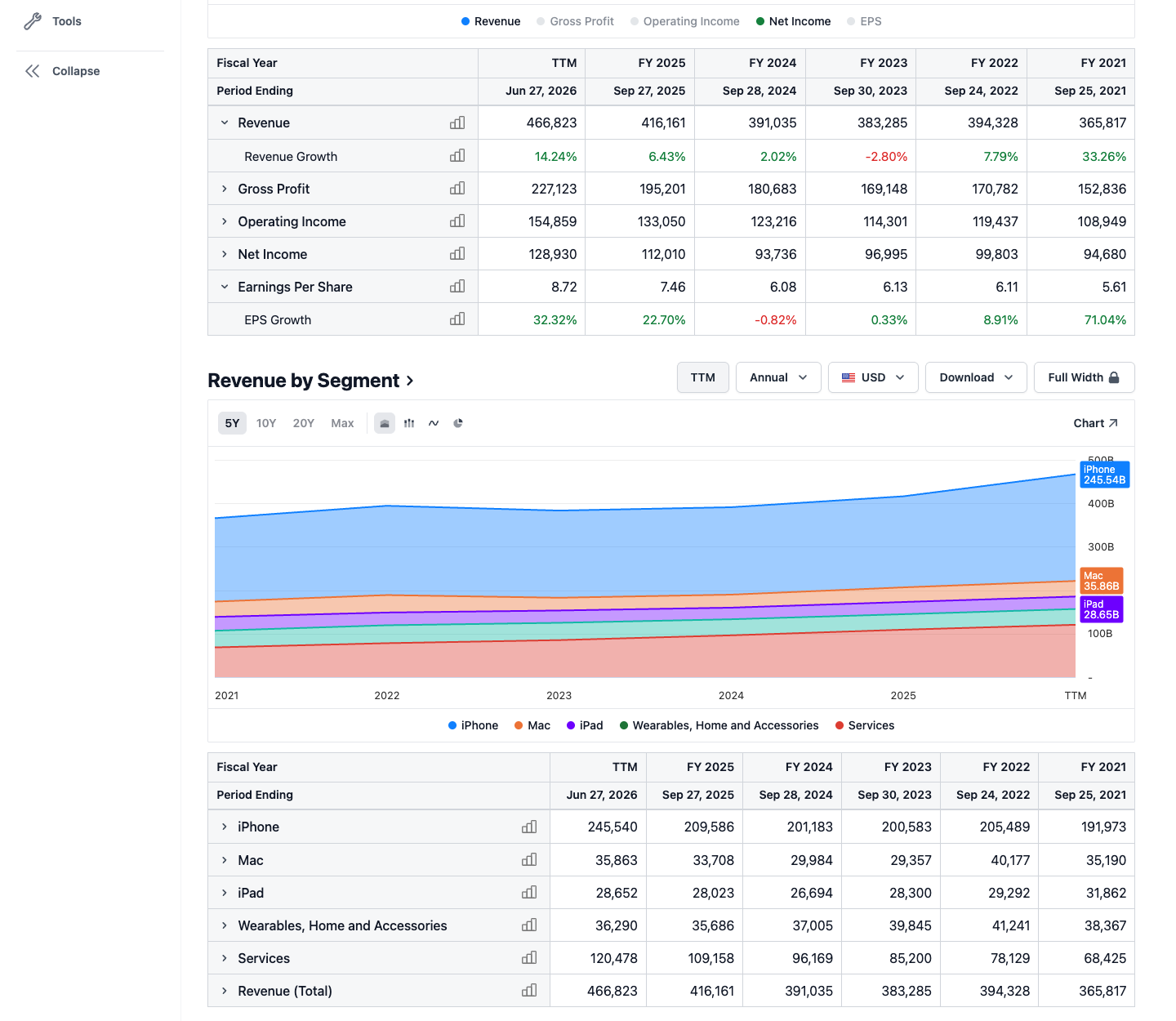
Notice the revenue line. The thesis sharpens the question: not “did revenue rise” but “did services rise faster than products”.
Two rules keep a thesis honest. First, every number in it must be checkable; ours trace to the 10-K’s revenue note and its products and services performance table, and the cross check is that the five categories sum exactly to the total. Second, the “prove me wrong” sentence must be real. If you cannot name what would break your thesis, you have written an advertisement. Ours names three: the services margin, the regulators, and China, where revenue has fallen 11.3% in two years. Notice that none of the three is “the share price falls”. The thesis is about the business; the price gets its own chapter later.
Try it yourself
Write your own four sentence thesis for Apple, using only these figures from the 10-K: iPhone $209.6 billion, services $109.2 billion at a 75.4% gross margin, total revenue $416.2 billion, services at 14.3% of revenue in fiscal 2017. Then swap companies: write the same four sentences for Microsoft from its StockAnalysis page. If a sentence has no number, delete it and try again.
Key takeaways
- A thesis is one paragraph: what the business is, why it wins, what the numbers must do, and what would prove you wrong.
- Write it before the analysis; everything after is a test of it.
- A thesis with no checkable figure is a mood. A thesis with no “prove me wrong” is an advertisement.
- Apple’s thesis in one line: the device is the toll booth, services are the toll, and the mix keeps shifting toward the toll.
Read one real thing: Item 1 of Apple’s fiscal 2025 10-K, the Business section. Notice how little of it is marketing: the company must describe what it sells, how it distributes (40% direct, 60% through others in fiscal 2025) and who it competes with, in language a court could hold it to.
Listen to this chapter
Read by Ritu, a synthetic voice from Sarvam AI