Using the Special Situations page, honestly
What you will learn
- Where our tracker lists event-type filings
- How to go from one listing to the actual SEC document
- What to write down about any event before trusting it
- Why these edges are real but smaller than the old books say
Everything in this module becomes useful only when you can find events yourself. Our free Special Situations page collects exactly these filings in one place: open it here.
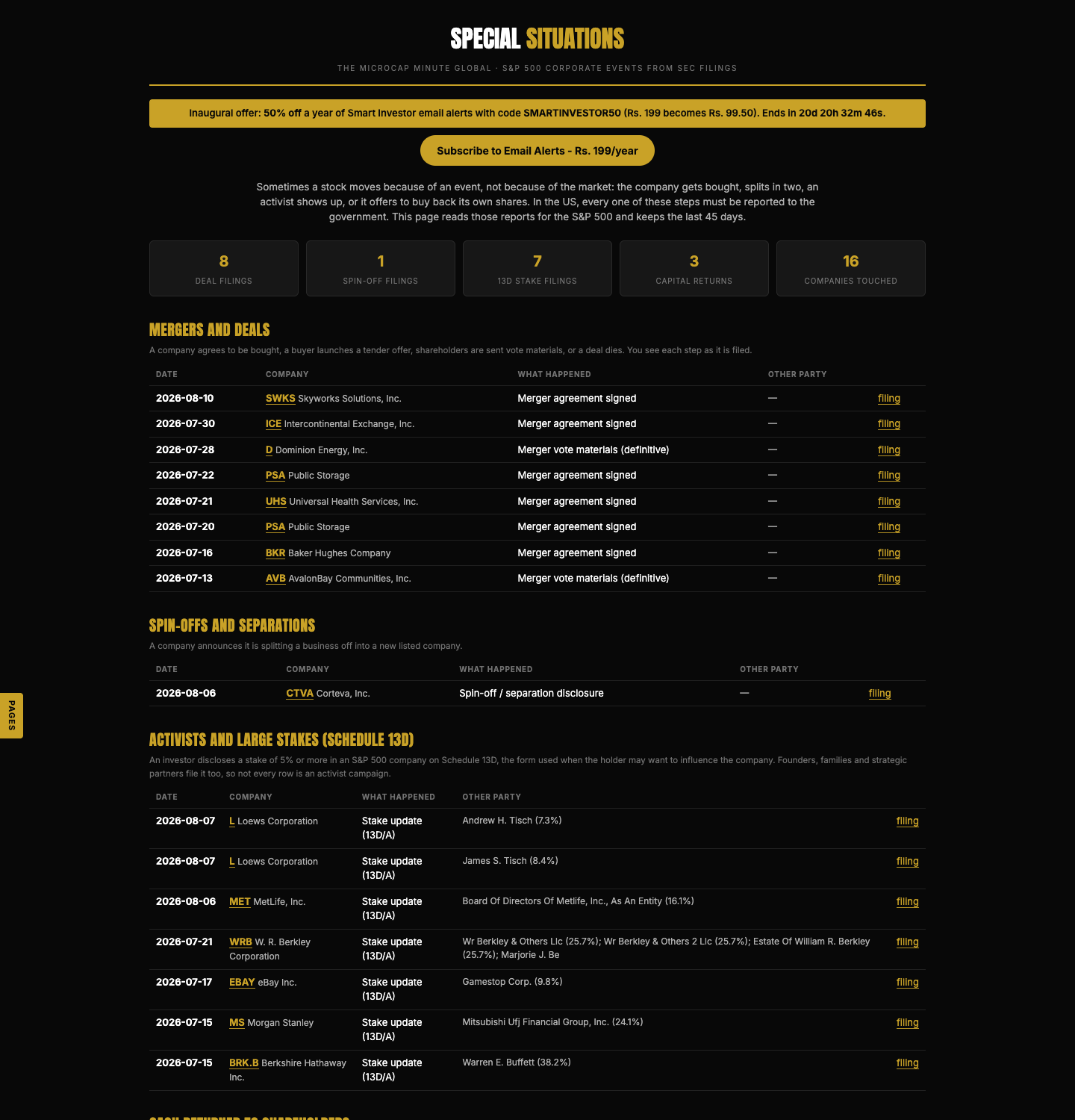 Notice the dated list of filings with their form types: each row is one event you can open and read.
What you will see there: 8-K filings announcing deals and leadership changes, 13D filings from investors pushing for change, tender offer filings (on EDGAR, a company bidding for its own shares files a Schedule TO, usually shown as SC TO-I), and registration statements like the Form 10 that spin-offs file before a split.
Here is the routine for any entry that catches your eye. One, click through to the actual filing on SEC.gov: the tracker’s job is to point, the filing’s job is to tell the truth. Two, write down three things: what event, what date or deadline, what price terms. Three, ask the question from each earlier chapter: who is forced to act here, and what could break?
 Notice how the special situations page is one filtered view of the same filing flow: events swim in ordinary news, and the skill is telling them apart.
The honesty section
You deserve the uncomfortable truth, because the old books will not give it to you.
Graham found these opportunities when almost nobody read filings. Buffett did merger arbitrage in the 1950s, when news travelled by post. Greenblatt wrote about spin-offs in 1997, before everyone had the internet. Today, computers read every SEC filing within seconds, and thousands of professionals hunt exactly the gaps this module describes.
So the edges are real, but thinner than the old books say, and now you have the numbers. The fund that bought every spin-off made about 13% a year where the plain index made 15.3%. The biggest merger-arbitrage fund made about 3% a year, and merger gaps have shrunk by more than 4 percentage points since 2002. Even the old index-addition trick has flipped sign. Costs and taxes eat small edges fastest. And a broken deal does not care that you are small and careful: it falls on everyone equally.
What remains for a patient young reader? Two things. First, understanding: when a stock lurches on an event, you will know why, while others panic or chase. Second, the smallest corners: situations too tiny for a billion-dollar fund to bother with still get mispriced sometimes. Knowledge compounds even when easy money does not.
Try it yourself (10 minutes): open the Special Situations page, pick one entry, and click through to its filing on SEC.gov. Write your three lines: event, deadline, price terms. Then write one more line: what would make this event fail? Keep the note. In three months, check whether the event actually happened.
Key takeaways
- The Special Situations page gathers event-type filings in one place, free.
- Always read the actual filing on SEC.gov, never just the listing.
- Note the event, the deadline, and the price terms before anything else.
- These edges are real but smaller than the old books claim; computers now read filings in seconds.
- Understanding events protects you from panic even when it does not make you money.
Read one real thing: Apple’s filing list on EDGAR. Notice how many different form types one ordinary company produces in a year: each type is a different kind of event, and you now know how to read the important ones.
Listen to this chapter
Read by Ritu, a synthetic voice from Sarvam AI