What a screener does: a filter for ten thousand stocks
What you will learn
- What a stock screener is, in one plain sentence
- Why the US market is too big to read company by company
- How a few conditions turn ten thousand names into a shortlist
- Why a shortlist is a list of questions, not answers
- Why one screen answers only one question at a time
Open any shopping app and type “cricket bat”. You get nine thousand results. So you tick the filters on the side: price under ₹3,000, rated four stars and above, English willow. Twenty bats remain. You have not bought anything. You have only made the pile small enough to look at.
A stock screener does exactly this for companies. A stock screener is a tool that filters a long list of companies by conditions you set, such as size, price, or profit, and shows you the names that pass. That is all it does, and it is enough.
Why you need one
The US market lists thousands of companies. Count the very small ones traded “over the counter” (meaning away from the big exchanges, often tiny firms with little public information) and the total is around ten thousand. Nobody can read ten thousand annual reports. Even one report a day would take about 27 years, and by then the first company would have changed beyond recognition.
So every serious reader starts with a sieve: shrink the market to a shortlist, then spend your reading hours only on the shortlist.
See it working
The screener on StockAnalysis is free and needs no login. It gives you boxes where you type conditions. Ask for companies worth more than $10 billion (about ₹90,000 crore) and thousands of names shrink to a few hundred. Add “must be profitable” and the pile shrinks again.
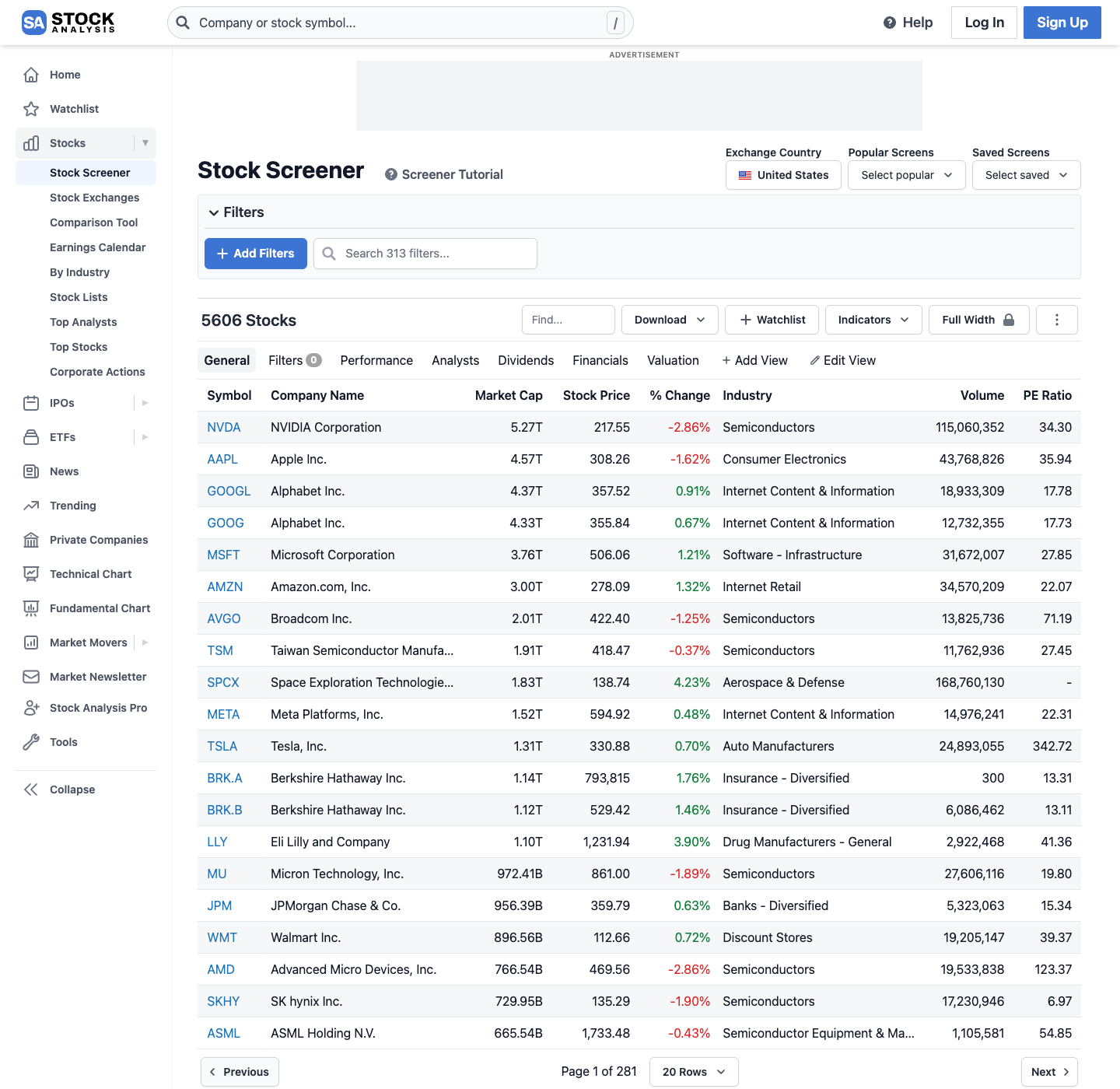
Notice the filter boxes: every condition you type removes companies, and the result list updates immediately.
Click any name in the results and you land on that company’s own page, with its price, its size, and its key numbers, one company at a time. Here is Apple’s:
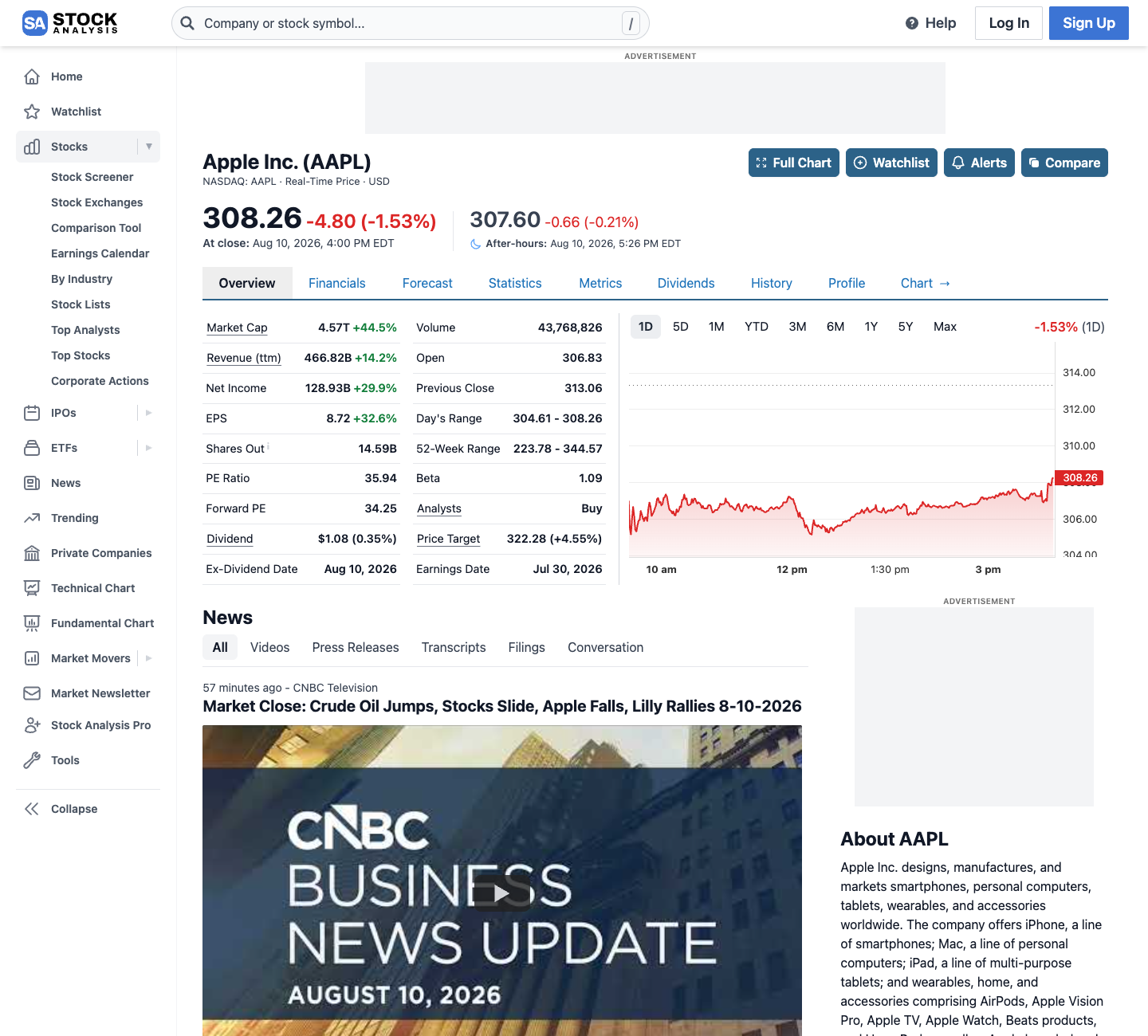
Notice how the screen has brought you to one company’s door; the reading starts from here.
One screen, one question
Most beginners open the screener and start typing conditions before deciding what they are asking. A screen answers one question at a time, so choose the question first. Filters about profit, debt, and growth ask: is this a good business at a fair price? That is this module’s question. There is a second question too: is money moving toward this company now? That one needs a different tool, the rotation map from Module 6, which shows which stocks are gaining ground on the market. A business screen cannot see money moving, and a money map knows nothing about the business.
The Microcap Minute’s own screen works in a fixed order. It asks the money question first: which companies are gaining ground on the S&P 500, the big list of five hundred large US companies, right now? Only then does it check each survivor’s business, using a card of fundamental numbers, meaning the facts about the business itself, like sales, profit, and debt. Money first, business second. Module 6 taught the money half; this module teaches the business half.
The one warning that matters most
A screener has read nothing. It matches numbers that other people typed in, and it does not know why any number is high or low. Passing a screen is like clearing the cut-off in an entrance exam: it gets you to the interview, not the seat. In this classroom, every name that passes still gets checked against the company’s own filings; Chapter 5 shows you how.
Try it yourself
Open the StockAnalysis screener. Set one condition: market value above $100 billion (market value, also called market capitalisation, is the total price of all of a company’s shares put together). Count the results. Now add a second condition: positive profit this year. Count again. Write down both numbers and one sentence about what the second filter removed.
Key takeaways
- A screener filters a huge list of stocks by conditions you set, like the filters on a shopping app.
- The US market has thousands of listed companies; a screener makes the pile readable.
- A shortlist is a list of candidates to check, never a list of things to buy.
- The screener itself has read nothing; the real checking happens later, in the filings.
- One screen, one question: business filters cannot see money moving, and a money map cannot see the business.
Read one real thing
Apple’s page on SEC EDGAR, the US regulator’s public filing cabinet: notice how many documents one company files in a single year. The screener has opened none of them.
Watch this chapter
The video edition, on our YouTube channel
Listen to this chapter
Read by Ritu, a synthetic voice from Sarvam AI