What a Business Earns: the Income Statement in Plain Words
What you will learn
- What an income statement is and the three levels of profit it shows
- The meaning of revenue, costs, and net income, in plain words
- How to read Apple’s real income statement without fear
- Why one unusual event can make a single year’s profit misleading
Imagine you run a small tiffin service for your apartment building. At the end of the month you want to know one thing: did I actually make money? So you open your notebook. On one side, every rupee that came in from customers. On the other, everything that went out: vegetables, gas, the delivery boy’s pay, the steel boxes. What remains at the bottom is your profit.
An income statement is exactly that notebook, kept by a company for a period of time, usually three months or a full year. It is also called the profit and loss statement, or P&L, because it shows whether the business ended the period in profit or in loss.
The words on the page
A few terms appear on every income statement. Learn them once and they are yours for life.
- Revenue (also called sales, or the top line): all the money that came in from selling things, before any costs are removed.
- Cost of goods sold: what it directly cost to make those things. For your tiffins, the vegetables and gas.
- Gross profit: revenue minus cost of goods sold. The first level of profit.
- Operating expenses: the costs of running the business day to day: salaries, rent, advertising, research.
- Operating income: gross profit minus operating expenses. Profit from the actual business, before interest and tax.
- Net income (the bottom line): what is left after absolutely everything, including interest and taxes. This is the profit that belongs to the owners.
One more useful idea: earnings per share, or EPS. That is net income divided by the number of shares, so it tells you how much profit sits behind a single share.
A real example: Apple
Apple is the company we will follow through this whole module. In its 2024 financial year (a company’s own twelve month accounting year; Apple’s ends in late September, not December), Apple reported:
- Revenue of about $391 billion. Since $1 billion is roughly ₹8,300 crore, that is about ₹32 lakh crore of sales in one year.
- Gross profit of about $181 billion. So out of every ₹100 of sales, about ₹46 survived the cost of making iPhones, Macs, and running services like iCloud.
- Operating income of about $123 billion.
- Net income of about $94 billion, roughly ₹7.8 lakh crore of profit in a single year.
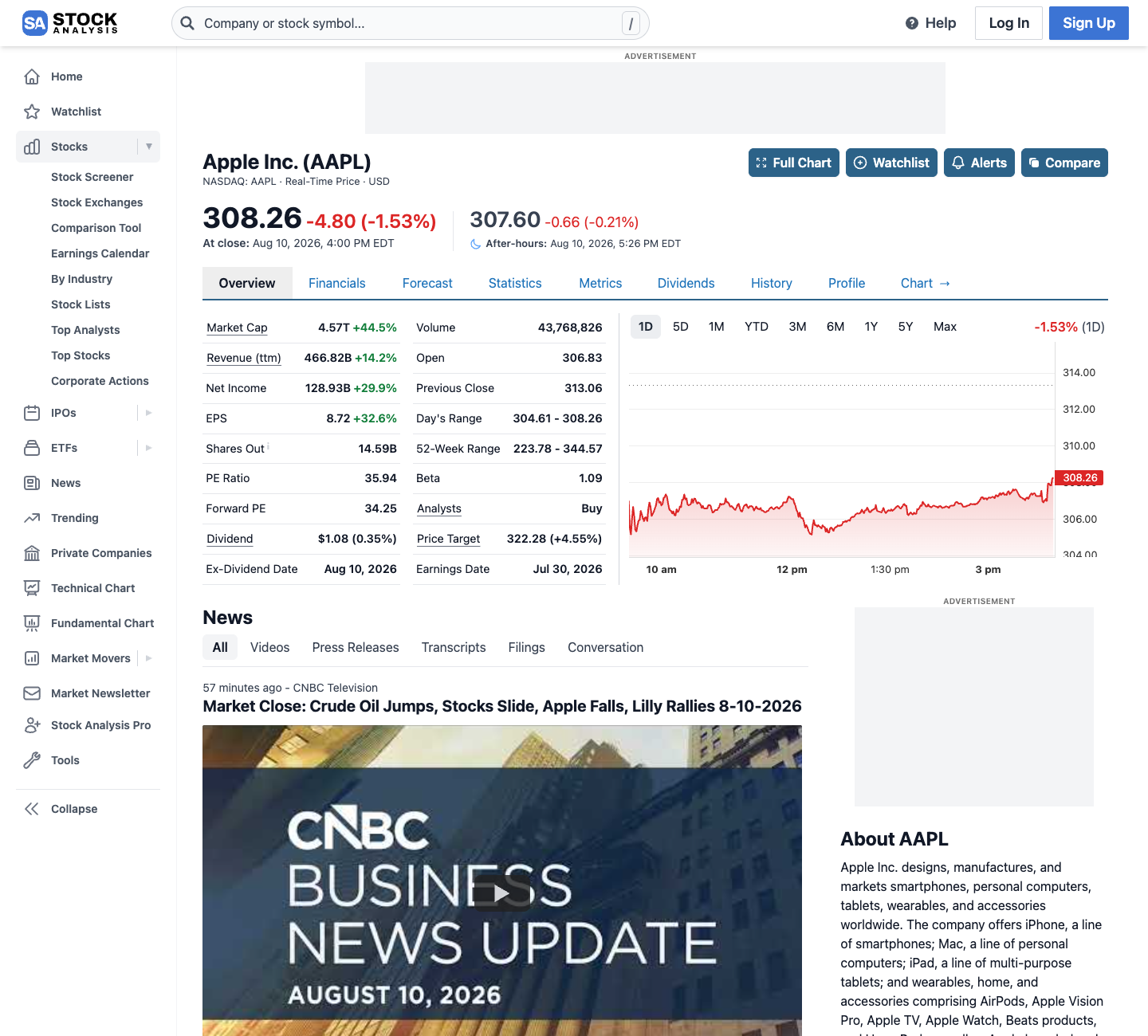
Notice the market cap line on this page: it is the price of the whole company at today’s share price, and we will use it properly in Chapter 5.
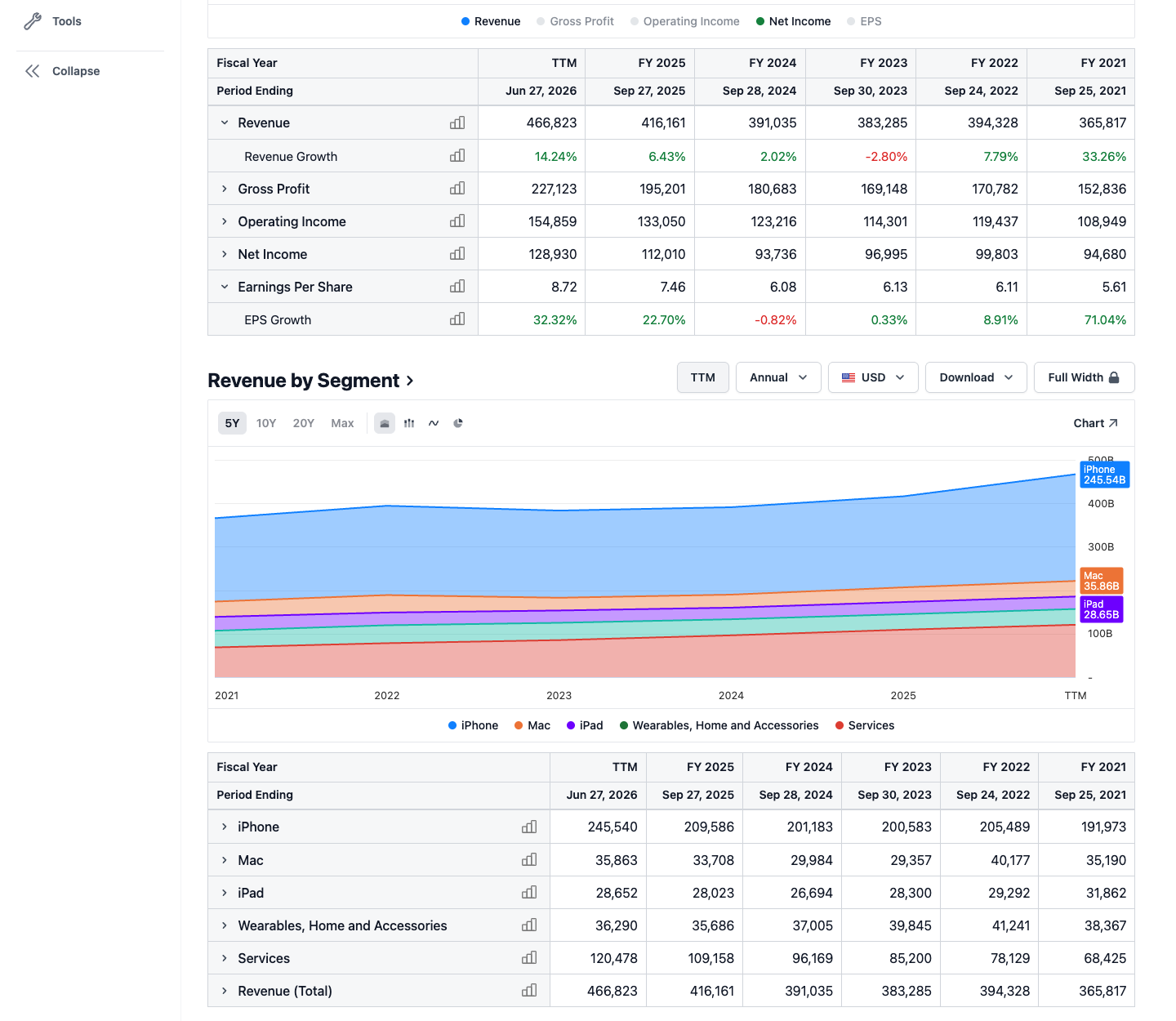
Notice the shape of the table: revenue at the very top, net income near the bottom, with costs peeling the money away layer by layer in between.
Now an honest note. Apple’s 2024 profit was pulled down by a large one-time tax payment in Europe; without it, profit would have crossed $100 billion. This happens all the time: a single unusual event can make one year look much better or worse than the business really is. When a number jumps oddly, the first habit to build is asking why. The company’s annual report always explains, usually in the notes to the statements.
That top to bottom shape, by the way, is why people say “top line” for revenue and “bottom line” for net income.
Try it yourself
Open Apple’s income statement on StockAnalysis. Find the revenue line and the net income line for the latest full year. On a calculator, divide net income by revenue and multiply by 100. That is the net margin: how many rupees of profit the company keeps out of every ₹100 of sales. Now find the same two lines one year earlier. Did the company keep more this year, or less?
Key takeaways
- An income statement is a money in, money out notebook for a period of time.
- Revenue is the top line; net income is the bottom line; gross and operating profit sit in between.
- EPS spreads the profit across all shares so you can think about one share at a time.
- One-time events can bend a single year’s profit; always ask why before trusting a number.
Read one real thing: Apple’s 2024 annual report (Form 10-K) on SEC.gov. Find the page called “Consolidated Statements of Operations” and notice it is the same table you just saw, filed by the company itself.
Watch this chapter
The video edition, on our YouTube channel
Listen to this chapter
Read by Ritu, a synthetic voice from Sarvam AI