What It Owns and Owes: the Balance Sheet
What you will learn
- What a balance sheet is and why it must always balance
- The meaning of assets, liabilities, and shareholders’ equity
- How to spot cash strength and debt risk on Apple’s real balance sheet
- Where the balance sheet sits inside the annual report
A quick game. List everything you own: a bicycle, your books, ₹500 in your piggy bank. Now list everything you owe: ₹200 you borrowed from your sister. The first list minus the second is what you are really worth.
A balance sheet does exactly this for a company, with one twist: it is a photo taken on one particular day, the last day of the quarter or the year. Sell a factory the next morning and the photo is already out of date. The income statement from Chapter 1 covered a whole period; the balance sheet freezes a single moment.
The three blocks
- Assets: everything the company owns or is owed. Current assets can turn into cash within a year: cash itself, inventory (unsold products), and receivables (money customers still owe). Non-current assets are the long-lived things: factories, offices, patents.
- Liabilities: everything the company owes. Current liabilities fall due within a year, like unpaid supplier bills. Long-term debt is money borrowed for many years.
- Shareholders’ equity (also called book value): what would be left for the owners if the company sold everything and paid every debt, at least on paper.
Now the golden rule, and it never breaks:
Assets = Liabilities + Shareholders’ Equity
It must balance, which is exactly why it is called a balance sheet. Every rupee of stuff a company owns was paid for in one of only two ways: with borrowed money (a liability) or with the owners’ money and past profits (equity).
Apple’s photo, September 2024
At the end of its 2024 financial year, Apple’s photo looked like this:
- Total assets of about $365 billion, roughly ₹30 lakh crore.
- Inside that, a cash mountain: about $157 billion in cash and investments.
- Total liabilities of about $308 billion, including roughly $107 billion of borrowed money.
- Shareholders’ equity of about $57 billion.
Check the rule yourself: $308 billion plus $57 billion makes $365 billion. It balances, as it must.
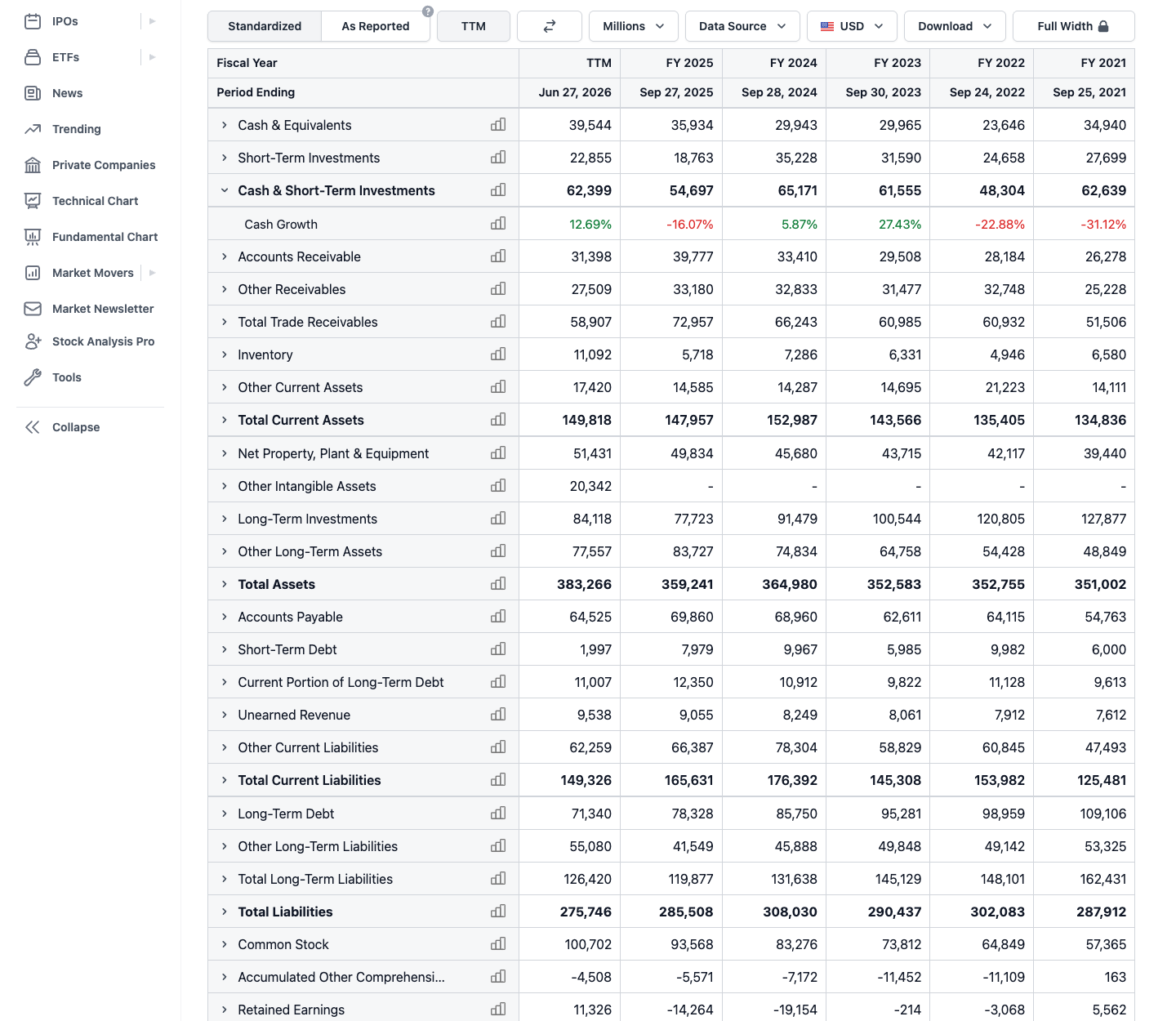
Notice the three big blocks in the table: assets first, then liabilities, then equity at the bottom.
Two things are worth pausing on. First, Apple’s debts look huge, but its cash and investments are even huger, so it could repay every rupee of debt from its own pile tomorrow. Cash bigger than debt is one of the strongest safety signs a balance sheet can show. Second, the equity looks oddly small for such a giant company. That is no accident: Apple has spent years sending profits back to shareholders, which shrinks the equity line (Chapter 6 shows the mechanics). Here, small equity is a side effect of generosity to owners, not weakness.
One habit to build early: every kind of business has its own idea of normal. A bank, for example, is in the business of money itself, so its balance sheet is mostly loans it has given and deposits it holds for customers. And banking rules force it to keep a thick cushion of shareholders’ equity, much thicker than a phone maker’s, so a bad year does not sink it. None of this makes a bank weak or strong. It makes it a bank. Keep this in mind for Chapter 4, where using one fixed measuring stick for every company turns out to be a trap.
Try it yourself
Open Apple’s balance sheet on StockAnalysis. Write down three numbers for the latest year: total assets, total liabilities, and total stockholders’ equity. Now test the golden rule with a calculator: does liabilities plus equity equal assets? It should, almost to the last million. Then compare total debt with cash and short-term investments. Which pile is bigger, and what does that say about safety?
Key takeaways
- A balance sheet is a photo of everything a company owns and owes, taken on one day.
- Assets minus liabilities equals shareholders’ equity; the equation always balances.
- Cash and investments bigger than total debt is a strong safety sign.
- Equity can shrink when a company returns lots of cash to owners; small is not automatically bad.
Read one real thing: Apple’s filing list on SEC.gov. Notice the 10-K form that appears once every year; the balance sheet photo inside it is always taken on the financial year’s last day.
Watch this chapter
The video edition, on our YouTube channel
Listen to this chapter
Read by Ritu, a synthetic voice from Sarvam AI