What a 10-K is and why it runs 300 pages
What you will learn
- What a 10-K is, and who forces companies to file one
- Why a document about one company can run to hundreds of pages
- How a 10-K is organised: four Parts and fifteen Items
- How to pull up any US company’s 10-K, free, in under a minute
Think about your school file. Not your report card, the whole file: attendance, the class teacher’s remarks, the medical note, the fee receipts, that warning letter from March. If someone wanted the full truth about your year, the report card alone would not do. They would need the file.
A 10-K (say “ten-K”) is a company’s full school file. It is a report that every company listed on a US stock exchange must file once a year with the Securities and Exchange Commission, or SEC, the American market watchdog. If you follow Indian markets, the SEC plays roughly the role SEBI plays here.
Three things make a 10-K special:
- It is audited. An outside accounting firm checks the numbers before they go in. Apple’s auditor is Ernst and Young, which has signed Apple’s accounts since 2009.
- It is sworn. The chief executive and the chief financial officer personally sign certificates saying the report is complete and truthful. Lying in a 10-K can send a boss to jail.
- It is on a clock. Large companies must file within 60 days of their year end. Apple’s accounting year, called its fiscal year, ends on the last Saturday of September, not on 31 December. Its 2025 10-K was filed on 31 October, about five weeks later.
Why so long?
Blame the rulebook, in a good way. The SEC lists everything a company must tell its owners, and the list is long: what the business does, what could go wrong, how the year went in management’s own words, the full audited accounts with their notes, who runs the company, and copies of important documents attached as exhibits. The result is a report with four Parts and fifteen numbered sections, called Items.
Apple’s 10-K is actually one of the shorter ones: about 60 pages for the main document. But the full filing carries 91 separate documents, and a big bank’s 10-K can run past 300 printed pages. Length is the price of completeness. Everything a reasonable investor might want to know has to be in there, and company lawyers make very sure it is.
Here is the good news: long does not mean unreadable. The structure is identical for every company, every year. Learn the map once and you can find anything in minutes. The last chapter of this module teaches a 45-minute skim.
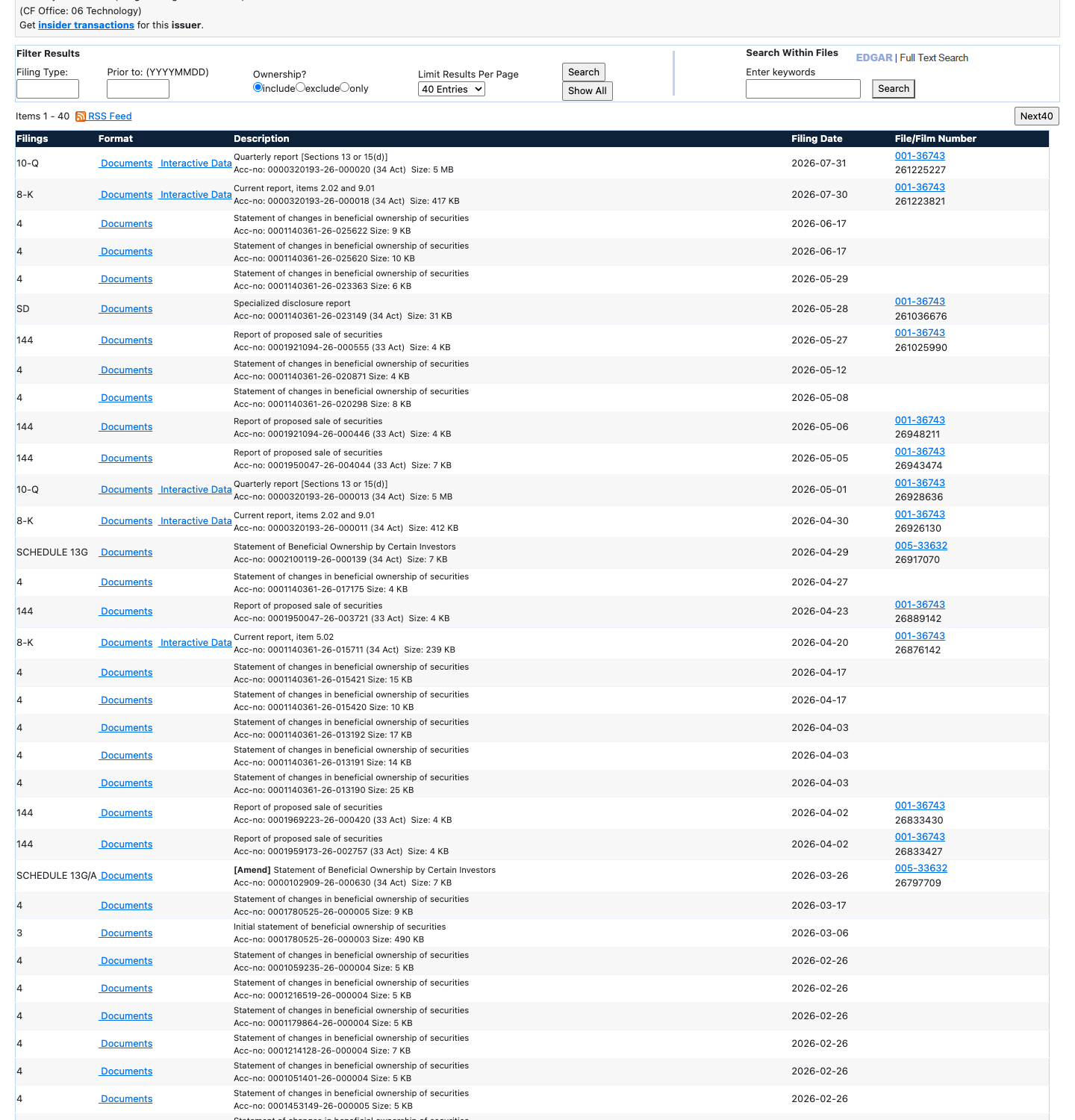
Every US filing Apple makes sits on one free SEC page called EDGAR (Electronic Data Gathering, Analysis and Retrieval, the government’s online filing cupboard). Notice the rhythm: exactly one 10-K a year, in late October or early November, like an annual exam result.
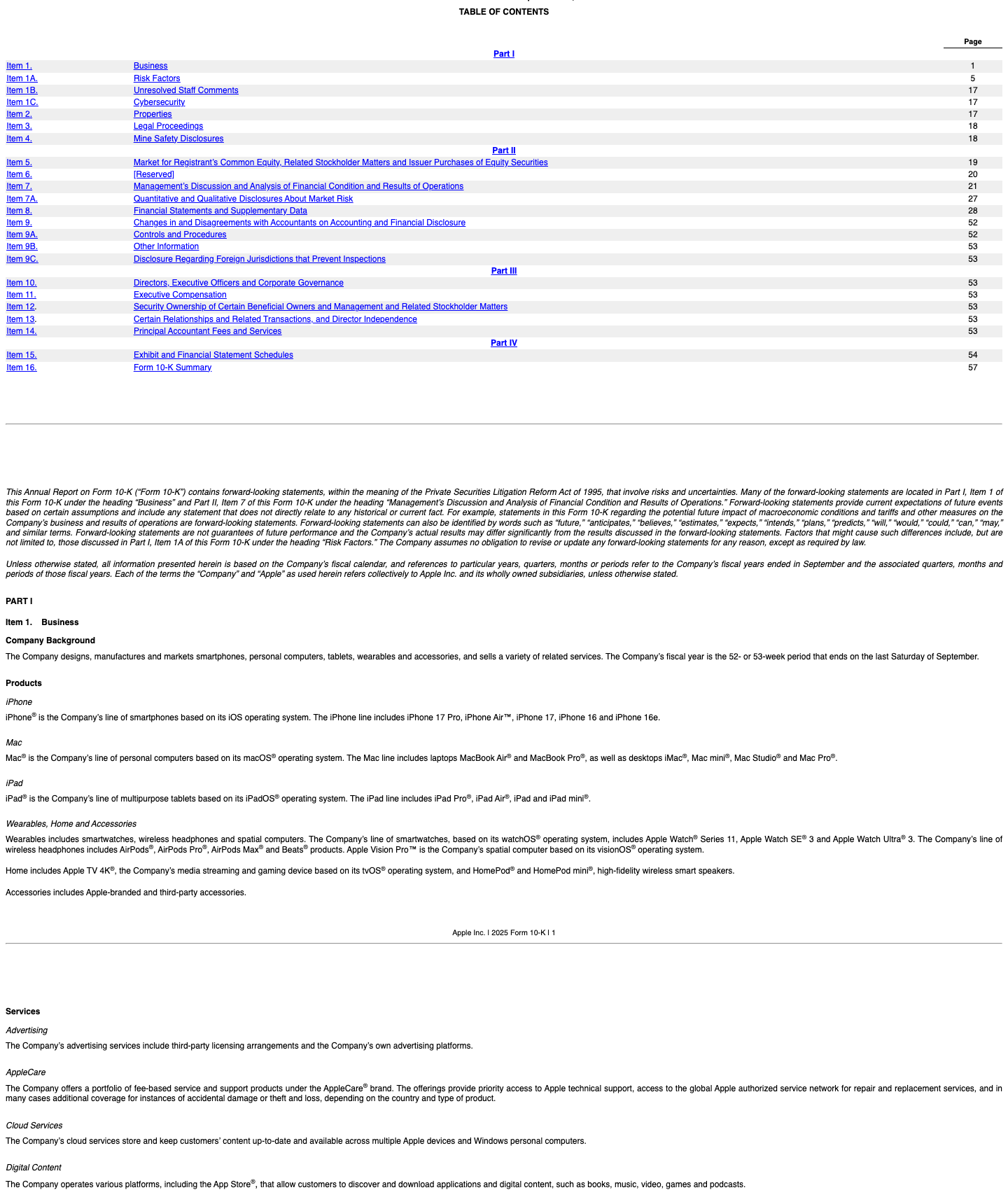
The table of contents is the map. Notice how Items 1 to 15 sit inside four Parts, and how the Business section (Item 1) starts on page 1 while the financial statements (Item 8) begin only on page 28.
Try it yourself
Go to sec.gov and open the EDGAR company search. Type “Apple”, open its filing list, and filter it to 10-K. Open the latest one and write down three things: the fiscal year end date, the filing date, and the page where Item 7 starts. Ten minutes, no login, no cost.
Key takeaways
- A 10-K is the complete yearly file every US-listed company must hand to the SEC, and anyone can read it free.
- It is audited by an outside firm, and the top two bosses personally certify it.
- It is long because the rules demand completeness: four Parts, fifteen Items, plus exhibits.
- Apple’s runs about 60 pages before exhibits; many companies run to 300. Length is normal, not a warning sign.
Read one real thing: the full document list of Apple’s 2025 10-K. Notice the main document, aapl-20250927.htm, and the two small files named EX-31.1 and EX-31.2: those are the signed truthfulness certificates.
Watch this chapter
The video edition, on our YouTube channel
Listen to this chapter
Read by Ritu, a synthetic voice from Sarvam AI