Item 1 Business: how the company actually makes money
What you will learn
- What Item 1 of a 10-K contains, and why it is the best first read
- The five questions Item 1 answers about any company
- How Apple actually makes its money, in its own words
- Why you should never assume you know a company’s business model
Imagine your friend’s family runs a kirana store. If someone asked “how does this shop earn?”, you would not show them the till. You would explain: what they sell, who buys from them, where the stock comes from, which months are busy, and which shop across the road fights them for customers. Item 1 of a 10-K is exactly that page for a company, written by the company itself.
Item 1 is almost all words, no tables. It answers five questions:
- What does it sell? The products and services, listed plainly.
- Who buys, and how does it reach them? Customers and sales channels.
- Who actually makes the stuff? Suppliers and factories.
- When is the busy season? Companies call this seasonality.
- Who does it fight? Competition, in the company’s own assessment.
Apple’s answers, from its 2025 10-K
The very first sentence of Item 1 describes the whole company: “The Company designs, manufactures and markets smartphones, personal computers, tablets, wearables and accessories, and sells a variety of related services.” One sentence, entire business.
The detail behind it:
- Products: five families. iPhone, Mac computers, iPad tablets, Wearables (Apple Watch, AirPods, Vision Pro), and Home and Accessories (Apple TV, HomePod, cables and cases).
- Services: advertising, AppleCare support plans, iCloud storage, the App Store and content subscriptions like Apple Music, and payment services like Apple Pay. This is the quiet giant: services brought in $109 billion in 2025, about ₹9.5 lakh crore at roughly ₹88 to a dollar.
- How it sells: 40% of sales through Apple’s own stores and website, 60% through partners like mobile carriers and electronics chains.
- Seasonality: the October to December quarter is the biggest, because of holiday shopping and new iPhones launching in September.
- Who makes it: mostly not Apple. A significant majority of manufacturing is done by outsourcing partners, mainly in China, India, Japan, South Korea, Taiwan and Vietnam.
- People: about 166,000 full-time equivalent employees (part-timers counted as fractions).
One detail for Indian readers: in Apple’s list of geographic segments, India sits inside “Europe”, because Apple groups Europe, India, the Middle East and Africa together. Never assume the map matches your school atlas.
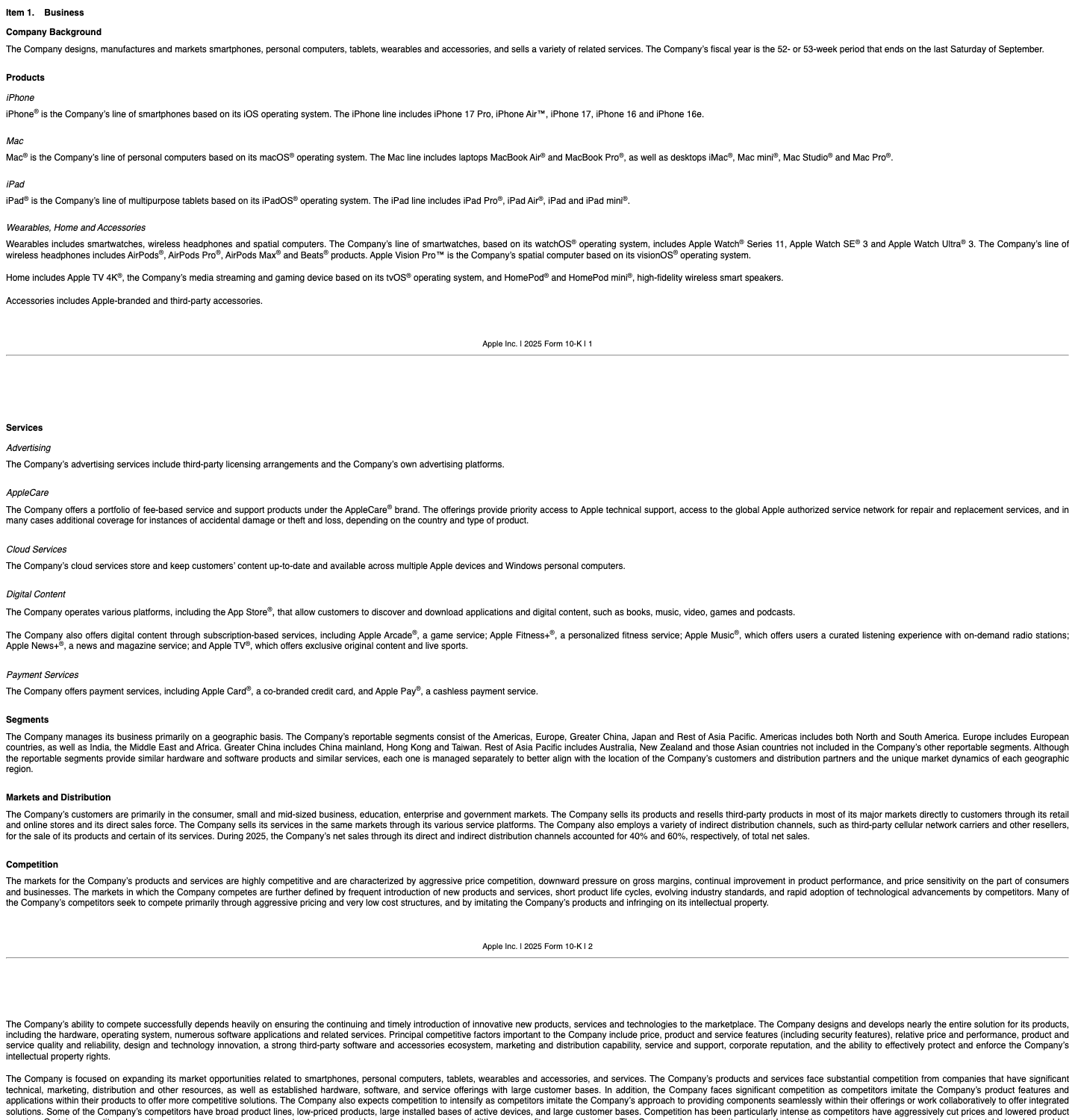
Notice how the filing opens with plain product descriptions, not numbers. The rupee figures and growth rates come later, in Item 7 and the notes.
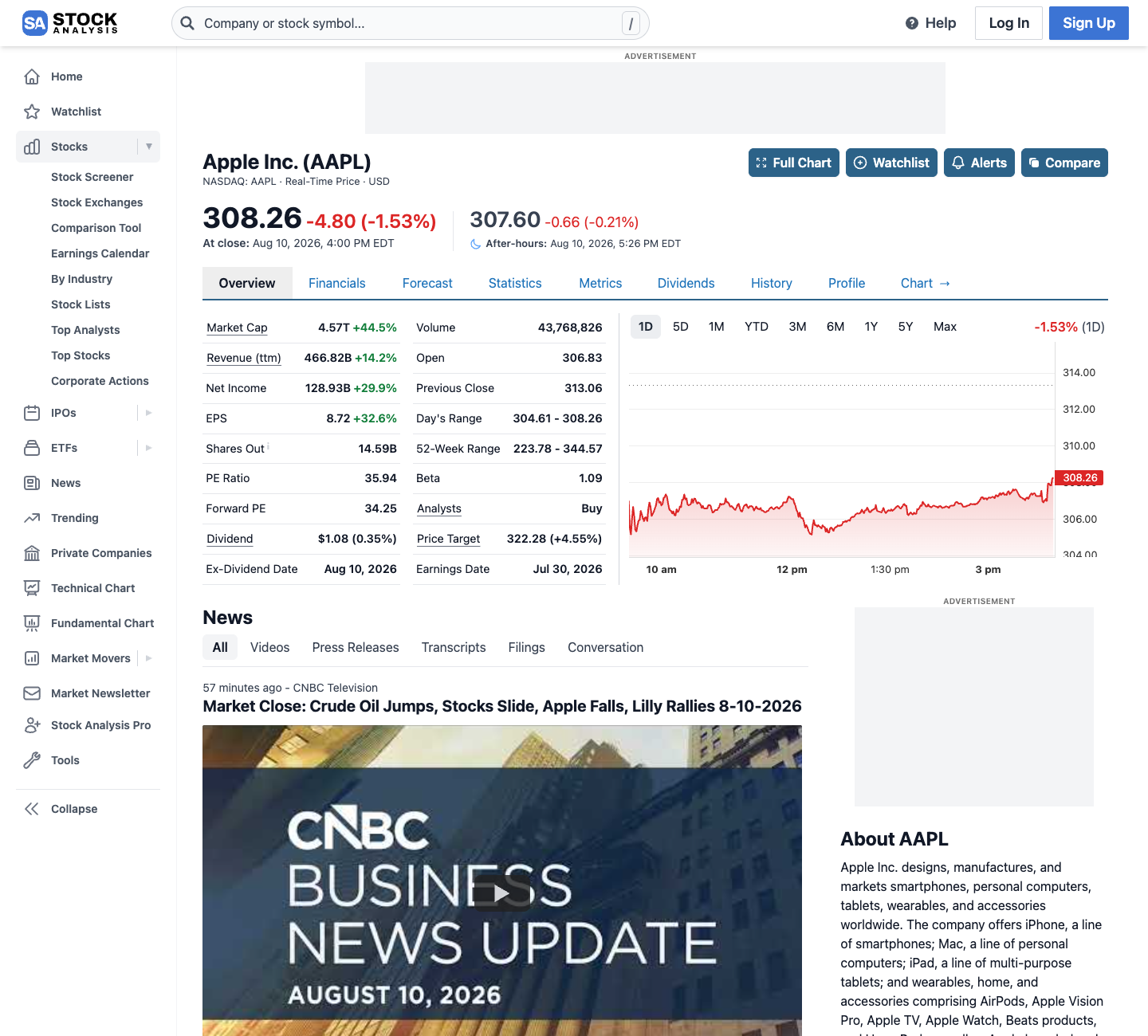
A summary site squeezes all of Item 1 into a few stats and a one-line description. Handy, but the filing is the source those summaries are built from.
And a warning from another company: most people think Coca-Cola sells bottles of Coke. Read its Item 1 and you learn it mainly sells concentrated syrup to bottling companies, which make and distribute the actual drinks. Same brand, completely different business. Always read Item 1 before assuming.
Try it yourself
Open Apple’s latest 10-K on EDGAR and read the first two pages of Item 1. Write five lines: what it sells, who buys, how it reaches them, the busy season, and who makes the products. Then open the Apple page on StockAnalysis and check how much of your five lines shows up there.
Key takeaways
- Item 1 answers “how does this company make money?” in plain words, before any numbers.
- Look for five things: what it sells, who buys, who makes it, the busy season, and the competition.
- Apple’s answer: five hardware families plus fast-growing services, mostly assembled by partners, busiest from October to December.
- Never assume the business model. Coca-Cola mainly sells syrup to bottlers, not bottles to you.
Read one real thing: Apple’s 2025 10-K. Notice the first sentence of Item 1: it describes the entire company in a single breath.
Listen to this chapter
Read by Ritu, a synthetic voice from Sarvam AI