Relative strength: beating the benchmark, not just rising
What you will learn
- What a benchmark is, and why every investor needs one
- What relative strength means, in plain words
- How to compare a stock’s return against the market’s return
- Why “my stock went up” can still be bad news
Imagine your class runs a race. Everyone runs, and the average student finishes in 60 seconds. You finish in 58 seconds. You beat the average, so you did well. Your friend finishes in 65 seconds. Your friend still finished the race, but slower than the average runner. Same track, same day, different result.
The stock market works exactly like this. On most days, most stocks move together because they all belong to the same big market. So to know if a stock is genuinely strong, you cannot just ask “did it go up?” You have to ask “did it go up more than the market?”
The benchmark: the average runner
A benchmark is a standard you compare things against. In US markets, the most common benchmark is the S&P 500, a list of 500 of the biggest American companies, packaged into one number you can track. When people say “the market was up 1% today”, they usually mean the S&P 500 was up 1%.
There is even a fund with the ticker SPY that simply copies the S&P 500, so its price is a handy stand-in for “the market”. A ticker is the short code for a stock or fund, like AAPL for Apple.
Relative strength: the gap between you and the average
Relative strength means how a stock performs compared to the benchmark, not compared to zero. The word “relative” is the key: strong or weak relative to the market.
Here is the idea with made-up numbers. Suppose over one year:
- The S&P 500 rises 10%
- Apple rises 18%
- Coca-Cola rises 4%
Apple beat the market by 8 percentage points. Its relative strength is positive: genuinely strong. Coca-Cola also rose, so a Coca-Cola holder made money, but it trailed the market by 6 points. Its relative strength is negative. It finished the race, slower than the average runner.
The painful version: the market rises 20% and your stock rises 5%. You made money, yet you would have done better owning the boring benchmark itself. And the sneaky version: the market falls 15% and your stock falls only 5%. You lost money, but your stock showed positive relative strength because it fell less. Relative strength is about the gap, not the direction.
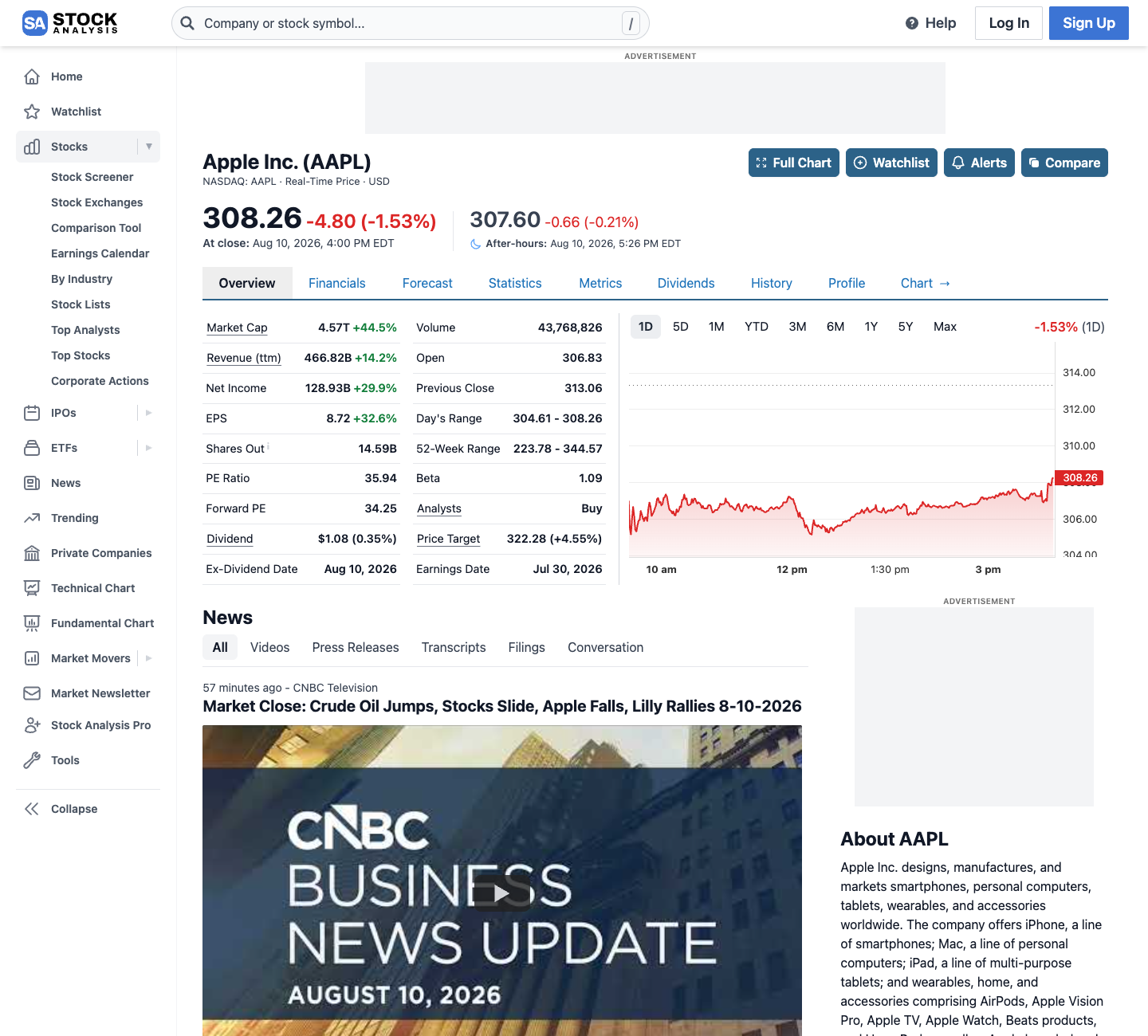 Notice the performance numbers near the top: this is where you read how Apple has done over different periods.
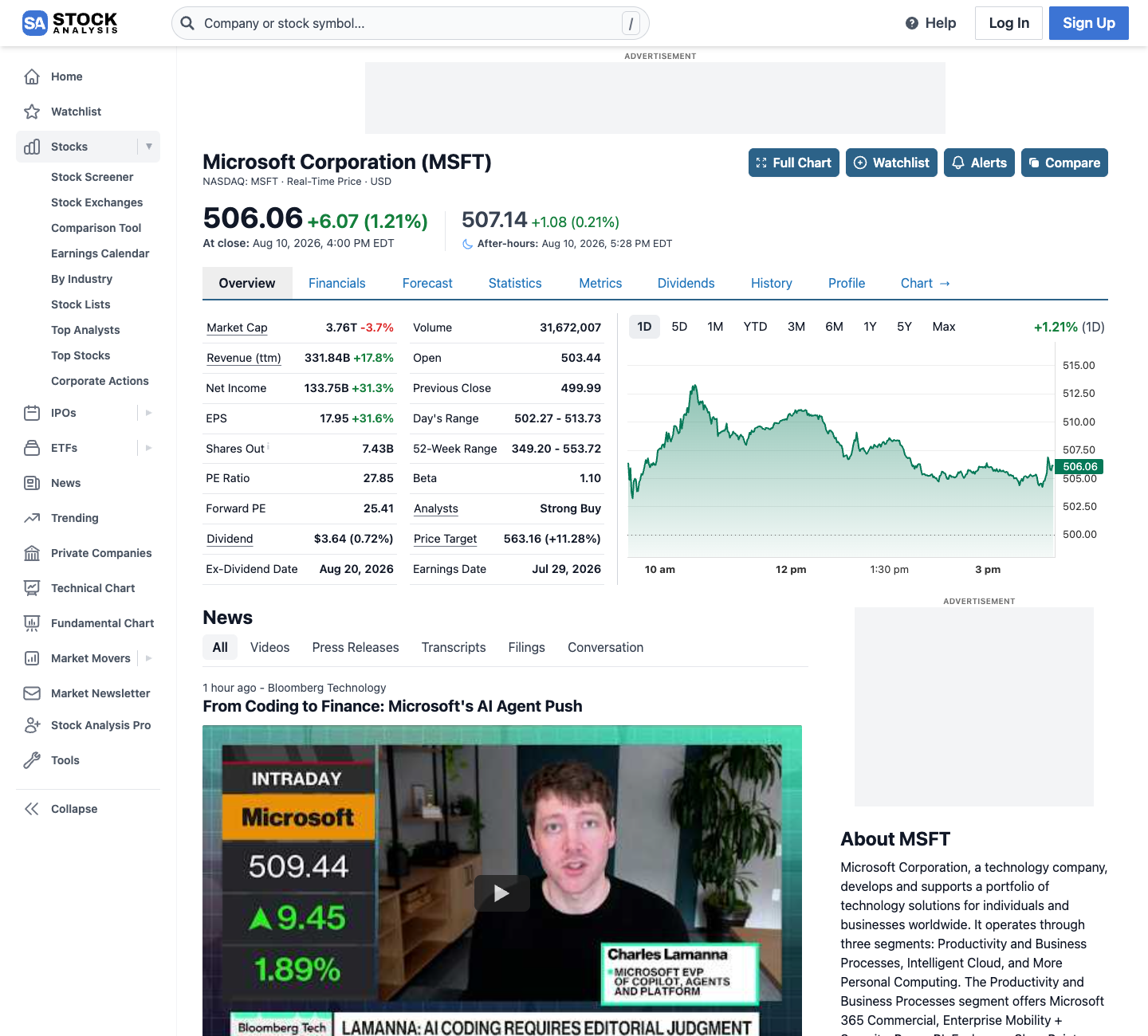 Same layout for Microsoft, so you can line the two companies up period by period.
A worked example you can check yourself
Open the StockAnalysis overview pages for Apple and Microsoft side by side. Both show returns over periods like 1 year and 5 years. Now ask the benchmark question: what did the S&P 500 do over the same period? StockAnalysis shows that too, right on the page.
Say Apple’s 1-year return is higher than the S&P 500’s 1-year return. Apple had positive relative strength over that year. If Microsoft’s is lower, Microsoft had negative relative strength, even if its price still went up. Neither result tells you what happens next year. It only tells you who beat the average runner over the period you measured.
One more thing: relative strength changes with the period you pick. A stock can be beating the market over 5 years and losing to it over 3 months. Always say the period out loud when you compare.
Try it yourself
Go to Apple’s overview page on StockAnalysis and find the 1-year return. Then look up the S&P 500’s 1-year return on the same site. Subtract the second from the first. If the answer is positive, Apple beat the market. Repeat for Coca-Cola (KO). Write both gaps in a notebook with today’s date.
Key takeaways
- A benchmark is your measuring stick; for US stocks it is usually the S&P 500.
- Relative strength is the gap between a stock’s return and the benchmark’s return.
- A stock that rises less than the market is relatively weak, even though it rose.
- A stock that falls less than the market is relatively strong, even though it fell.
- Always state the time period: relative strength over 1 year and over 3 months can disagree.
Read one real thing
Read Apple’s overview page on StockAnalysis. Notice how the returns are shown for several periods, and how different the story can look at 1 month versus 5 years.
Watch this chapter
The video edition, on our YouTube channel
Listen to this chapter
Read by Ritu, a synthetic voice from Sarvam AI