Reading a superinvestor’s portfolio without copying it
What you will learn
- What a superinvestor portfolio page actually shows you
- Why copying a famous portfolio is not a strategy
- How the thirty tracked investors were picked, and why not by size
- How to read position sizes and quarter-to-quarter changes
- The right use of a 13F list: a check on homework, not a shopping list
Suppose the most successful kirana store owner in your city had to publish his stock list every quarter. You would see he bought 200 sacks of rice in January. But by the time you read the list in May, the price has changed, he may have sold half of it, and he paid a wholesale price you never will. Reading his list is useful. Copying it is not.
A superinvestor is simply a famous fund manager with a long, public record. Our Smart Investor Tracker collects the 13F holdings of thirty of them on one page: the portfolios page.
Picked by concentration, not by size
The obvious way to pick investors to track is by who manages the most money. It is the wrong way. A 13F tells you what somebody owned weeks ago, never why, so what matters is how much of one person’s judgement each position carries. A fund that owns two hundred stocks tells you almost nothing by adding one more. A fund that owns five tells you everything it knows. Think of two cricket coaches: one rotates two hundred players, the other backs just five. Every pick of the second coach means something.
The thirty were chosen from about ninety seven names: concentration first, then whether the person on the label still makes the decisions, then the record, then how fresh the filings are. Some famous names fail these checks. One celebrated fund’s portfolio has not moved since its founder died: a museum piece, not a signal. Another star manager returned his investors’ money and stopped filing at all.
A worked example: Berkshire’s list
Open the portfolios page and pick Berkshire Hathaway. You will usually find Apple near the top, and Coca-Cola, held for decades, not far away. The column that matters most is the weight: what share of the whole portfolio each stock takes. At times Berkshire has kept more than a third of its stock money in Apple alone. Weight is conviction (belief backed by real money) made visible.

Notice that each portfolio shows holdings with weights, so you can spot what matters most at a glance.
Three reasons copying fails
One: the photo is old. A 13F can be 45 days late, so the price on your screen today is not the price they paid.
Two: you do not know the reason. Berkshire first bought Coca-Cola in 1988, at prices that will never return. When you copy the holding, you copy it without the homework, the entry price, or the thirty years of patience.
Three: your life is different. A giant fund can wait ten years and survive a 50% fall. A family saving for college fees cannot. And superinvestors are wrong sometimes: every famous name has held stocks that later sank. A famous owner is not a safety certificate.
The right way to use the list
Treat a superinvestor’s portfolio the way the tracker’s own builders do: the list is not where ideas start. Your own homework comes first, as the earlier modules taught you. The list earns its keep after that. Suppose you have studied a company and find that four careful, concentrated investors have owned it for three years. That is a reason to go read why. If none of them will touch a company you like, that is a question you must answer first. The list gives you questions. Only your own work gives you answers.
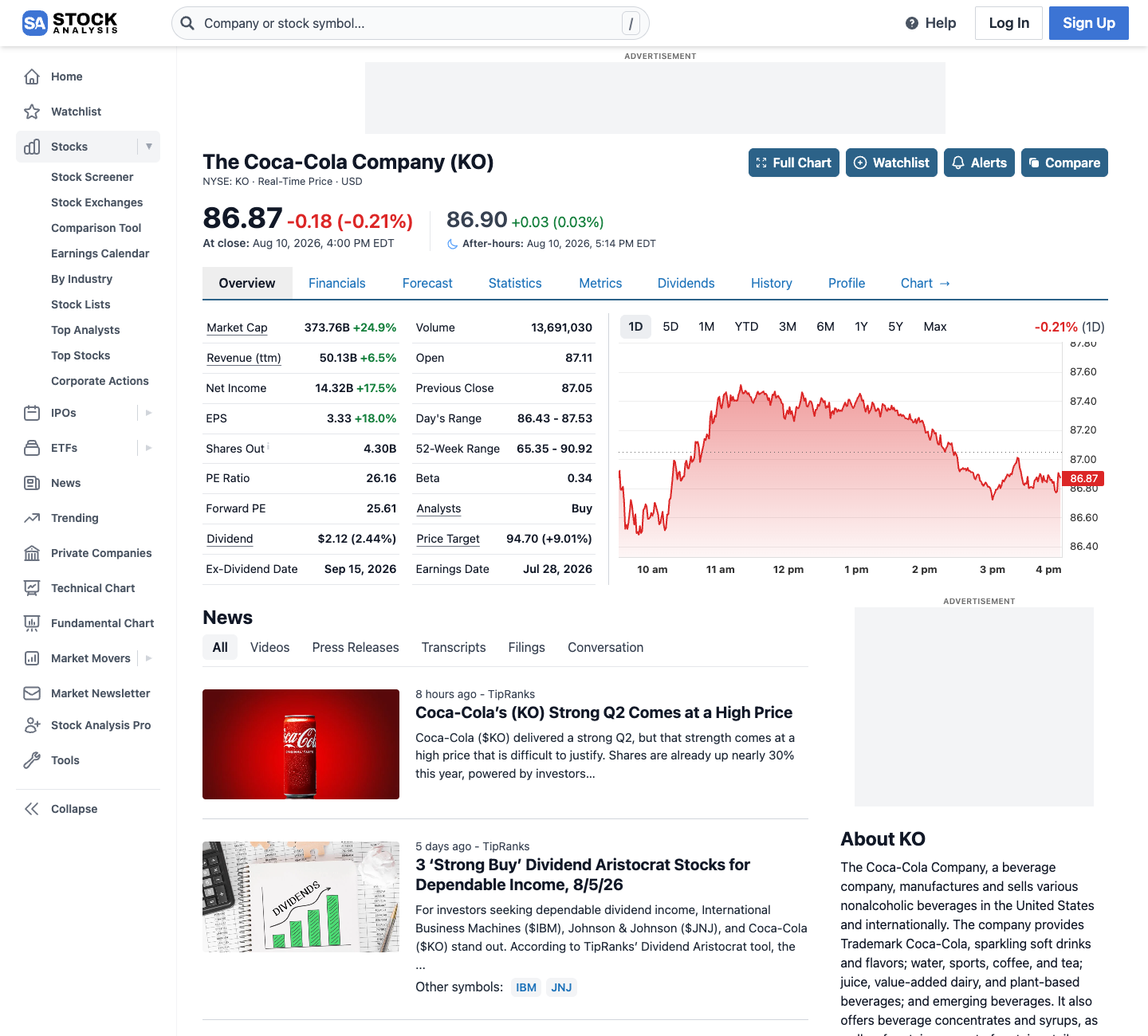
A company page like Coca-Cola’s is where your own research begins, not the fund’s list.
Try it yourself
Open the portfolios page, choose one investor, and find their largest holding. Now open that company on StockAnalysis and write one honest sentence: what does this company sell, and who pays it? If you cannot answer in one sentence, the stock goes on your “too hard” list, no matter who owns it.
Key takeaways
- A superinvestor’s portfolio tells you what they owned. Never why, at what price, or for how long.
- Copying is not a strategy: the data is 45 days old, your situation differs, and famous investors are wrong sometimes too.
- Weight shows conviction; changes between quarters show fresh thinking.
- The thirty are picked by concentration, not size: a five-stock fund says more than a two-hundred-stock fund.
- The list is a check on homework you have already done, not a source of names.
Read one real thing: Coca-Cola on StockAnalysis. Notice how much you can learn about a famous holding without anyone telling you to buy it.
Listen to this chapter
Read by Ritu, a synthetic voice from Sarvam AI